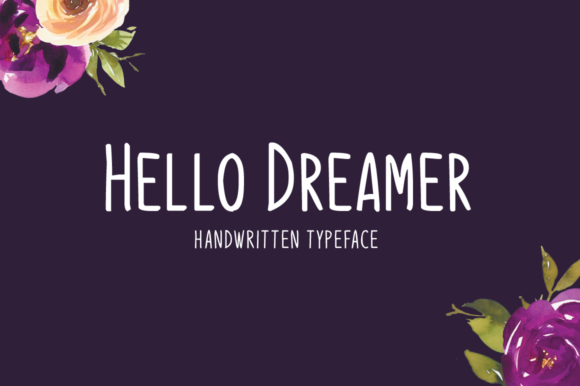
Hello Dreamer: A Sweet Script Handwritten Font for Makers
It was 3 a.m., and I was tweaking the label for my lavender-vanilla soy candle—again. The design looked clean, but something felt off. The sans serif title read “Calm Nights,” but it lacked warmth. Then I opened my fonts folder, scrolled past the bold display fonts and tight serifs, and landed on Hello Dreamer. One click, typed “Hello Dreamer” in soft charcoal gray over cream kraft paper, and suddenly—the label breathed. That’s the quiet magic of this Script Handwritten font: it doesn’t shout. It leans in, smiles, and makes your handmade product feel like it was made just for someone’s hands.
Hello Dreamer for Candle Labels and Natural Product Packaging
Hello Dreamer is a Script Handwritten font built for authenticity—not perfection. Its slight variation in stroke weight, gentle slant, and organic spacing mimic real pen-on-paper motion, so when you use it for candle labels, soap tags, or small-batch skincare packaging, it reinforces that human-made, thoughtful quality. I tested it at 14 pt on a 2" x 1.5" sticker—cut cleanly on my Cricut Maker with no jagged edges—and it held its charm even at that size. For best readability on physical labels, stick to short phrases (“Soothing Lavender,” “Hand-Poured,” “Made With Care”) and avoid dense paragraphs. Pair Hello Dreamer with a light, airy sans serif (like Montserrat Light or Poppins) for ingredient lists or certifications—it creates instant visual hierarchy without competing.
Hello Dreamer for Greeting Cards and Handmade Stationery
There’s a reason my birthday card mockups always land faster when Hello Dreamer is in the mix. As a Script Handwritten font, it brings tactile warmth to digital files—especially when layered over watercolor textures or pressed-flower scans. I used it for the “Happy Birthday” headline on a folded A6 card, then switched to a simple serif (Lora Regular) for the inside message. The contrast felt intentional, not cluttered. Because Hello Dreamer includes standard OpenType features—ligatures, contextual alternates, and baseline consistency—it avoids awkward letter collisions (no “r” bumping into “o,” no “f” clipping into “l”). That means fewer manual tweaks before printing, whether you’re running 10 cards on an inkjet or 100 on a local press.
Hello Dreamer for Wedding Invitations and Elegant Branding
When a friend asked me to design her wedding suite—letterpress-printed on cotton paper—I reached for Hello Dreamer first. Not for every line—but for the couple’s names, the date, and “Join Us” on the main invitation. Its natural flow and friendly elegance sit beautifully between rustic charm and refined simplicity—no stiff calligraphy, no over-the-top flourishes. As a Script Handwritten font, it invites intimacy, which matters when guests hold something tangible in their hands. I paired it with a delicate serif (Cormorant Garamond) for body text and kept all caps to a minimum—Hello Dreamer shines in sentence case, where its rhythm feels conversational and sincere.
Hello Dreamer for Printable Wall Art and Digital Downloads
If you create printable wall art, planner pages, or quote-based digital downloads, Hello Dreamer is one of those Fonts that lifts your entire shop aesthetic. I designed a set of “Dream Big” affirmations using Hello Dreamer as the focal phrase, then added subtle shadow layers and soft gradients in Canva. Because the font’s x-height is generous and its lowercase letters have open counters (the enclosed space in “e,” “a,” “o”), it stays legible even when scaled down for phone wallpapers or 5x7 digital prints. Bonus: it’s fully compatible with commercial licensing—so when you bundle it into a planner template or SVG cut file for Etsy, you’re covered, provided your license includes commercial use.
Hello Dreamer for Boutique Tags, Tote Bags, and Seasonal Merchandise
Last fall, I screen-printed a run of linen tote bags for a local gift shop. The tagline? “Hello, Autumn.” Using Hello Dreamer, I adjusted tracking slightly to give each letter breathing room on the curved seam of the bag—and it worked. As a Script Handwritten font, it adds personality without looking childish or dated. For heat-transfer vinyl on mugs or shirts, I recommend testing at 36–48 pt with simplified outlines (avoid ultra-thin swashes if your machine struggles with fine details). And yes—it works for holiday tags, spring seed packet labels, and summer market banners. Its versatility isn’t theoretical; it’s proven across seasons, substrates, and scales.
Hello Dreamer for Planner Pages and Creative Font Pairing
My weekly planner spreads live or die by typography—and Hello Dreamer is my go-to for headers, section dividers, and motivational headers like “Breathe,” “Begin,” or “You’ve Got This.” As a Script Handwritten font, it adds softness without sacrificing clarity. I pair it with a neutral sans serif (Inter or Work Sans) for checkboxes, dates, and notes—keeping the layout functional but never sterile. If you’re building digital planner templates in GoodNotes or Notion, Hello Dreamer renders crisply at all zoom levels, and its consistent metrics mean grids and margins stay predictable. Just double-check your font file includes both .OTF and .TTF versions—some design apps prefer one over the other.
Hello Dreamer for Cricut and Silhouette Projects with Real-World Readability
Here’s what I learned after cutting 200+ Hello Dreamer stickers: test at actual size *before* sending to your machine. This Script Handwritten font handles curves and joins beautifully—but tiny text under 10 pt can blur on vinyl or thin paper. For Cricut Design Space or Silhouette Studio, convert text to outlines only if you need pixel-perfect cuts (and remember to embed the font in PDFs for print shops). Also: check your license. Most Fonts labeled “commercial use” let you sell physical products made with them—but selling editable templates or SVG bundles requires extended rights. When in doubt, review the included license PDF—it’s usually clearer than any blog post.