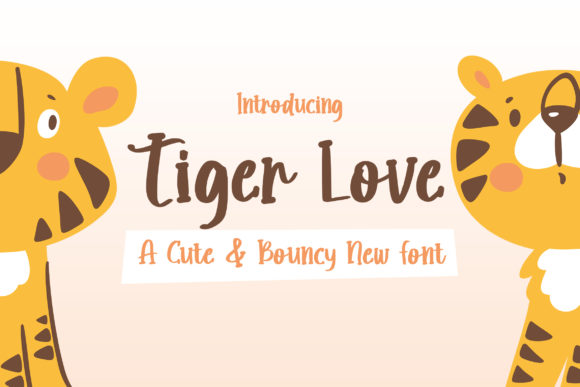
Tiger Love: A Cute and Quirky Halloween Script Handwritten Font
As a web designer who ships landing pages, SaaS dashboards, and boutique online stores weekly, I reach for Tiger Love when I need a Script Handwritten font that delivers personality without sacrificing digital clarity. Tiger Love isn’t just another decorative typeface—it’s a Halloween-themed handwritten font engineered for impact in real-world UI contexts: hero banners, limited-time offer badges, seasonal product cards, and brand-forward email headers. Its playful bounce, uneven baseline, and subtle ink texture give it authenticity—yet its generous x-height and open counters keep it surprisingly legible at 24px on mobile and crisp even over gradient overlays.
Tiger Love for Halloween Landing Pages and Seasonal Campaigns
When you’re building a time-sensitive campaign—like a spooky October product launch, a haunted e-commerce collection, or a themed digital course—Tiger Love instantly signals tone before the first word is read. Used as a hero headline (36–60px) over a dark background with soft drop shadow, it creates strong visual hierarchy while reinforcing seasonal relevance. Unlike overly ornate script fonts that vanish on small screens, Tiger Love holds shape at 28px on tablet view and remains scannable in responsive layouts. Pair it with a clean sans serif like Inter or Manrope for body copy—this contrast boosts readability and guides users toward CTAs without visual fatigue.
Tiger Love for Online Store Banners and Product Badges
Tiger Love shines brightest where brevity meets branding: “BOO! 30% OFF,” “Spooky Sale Ends Soon,” or “Limited-Edition Treats.” As a Script Handwritten display font, it transforms static banners into memorable micro-experiences. On Shopify or WooCommerce storefronts, I apply Tiger Love to SVG-based badges and animated promo bars—not as body text, but as high-impact accents that align with brand voice. It works best at 20–32px on light backgrounds (with subtle stroke or text-shadow for contrast) and 24–40px on dark mode variants. Avoid using it below 18px or in dense navigation menus—this Fonts family thrives in expressive, intentional moments, not functional UI elements.
Tiger Love for Creative Portfolio Headers and Brand Kits
Creative entrepreneurs—illustrators, lettering artists, Halloween-themed content creators—use Tiger Love to reinforce niche identity across their entire digital presence. In portfolio headers, it adds warmth and approachability without leaning childish; in branded Notion templates or Canva brand kits, it anchors visual consistency across social thumbnails, email signatures, and digital press kits. Because Tiger Love is a true Script Handwritten font (not a brush simulation), its letterforms retain natural flow and rhythm—ideal for hand-drawn aesthetics that still feel professionally polished. For maximum versatility, pair it with a neutral serif like Lora for blog intros or a geometric sans like Poppins for supporting UI labels.
Tiger Love for Email Subject Lines and Social Media Graphics
In crowded inboxes and fast-scrolling feeds, Tiger Love cuts through noise. When exported as a web-safe image or embedded via email client-compatible PNG (with transparent background), its quirky charm lifts open rates for seasonal newsletters. On Instagram carousels or Pinterest pins, Tiger Love used at 48–72px over moody photo overlays communicates “Halloween fun” faster than any stock illustration. Just remember: always test contrast ratios—especially over textured or busy backgrounds—and never rely solely on Tiger Love for critical information like dates or pricing. Reserve it for emotional hooks (“Trick or Treat Your Inbox!”), not functional data.
Tiger Love for Mobile App Splash Screens and Onboarding Illustrations
Yes—Tiger Love works in app design, too. When integrated as a webfont (WOFF2) or embedded via variable font loading strategies, it renders cleanly on iOS and Android devices. I’ve used Tiger Love successfully in splash screens for seasonal productivity apps and kids’ learning tools with Halloween themes—always at scale (40–80px), always centered, always paired with ample whitespace. Its uneven baseline and slight irregularity add human warmth missing from sterile system fonts, helping users emotionally connect before they even tap “Get Started.” Just ensure fallback fonts are declared in CSS for graceful degradation.
Tiger Love for Logo Text and Branded Web Components
Tiger Love is not a full-logotype solution—but it *is* an excellent logo accent font. Think: a boutique candle brand named “Midnight Howl” using Tiger Love for the word “Howl” beside a minimalist icon, or a tarot subscription service applying it only to the tagline “Readings with Spirit.” As a Script Handwritten font, it brings craft and character to otherwise minimal interfaces. Licensing matters here: confirm your Fonts license permits logo use, web embedding, and redistribution in client-facing digital assets. Most premium Tiger Love licenses cover exactly that—including use in Figma design systems, client landing pages, and white-labeled SaaS dashboards.
Tiger Love for Dark Mode Interfaces and Responsive Typography Systems
Contrary to assumptions about playful fonts, Tiger Love adapts well to dark mode—especially when paired with a 1–2px subtle outer glow or light text-shadow. Its thick-to-thin strokes and rounded terminals prevent visual “muddiness” against deep charcoal or navy backgrounds. In responsive typography systems, I define Tiger Love as a display-only font: font-family: 'Tiger Love', system-ui, sans-serif;, with strict size scaling rules (e.g., clamp(24px, 4vw, 48px)). Never force it into paragraph text or form labels—but deploy it confidently in section dividers, testimonial quotes, and CTA buttons where tone > utility. That balance is why Tiger Love earns repeat use across my client projects, not just seasonal ones.