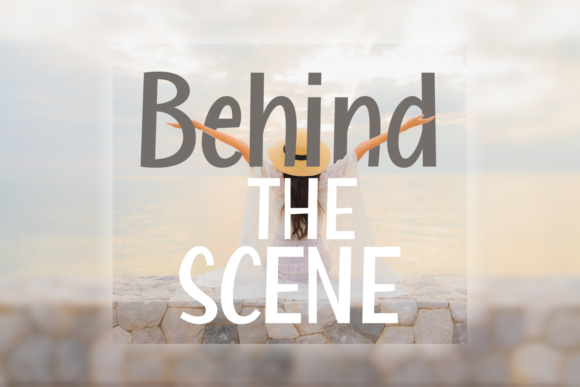
Behind the Scene: A Script Handwritten Font for Digital Branding
Behind the Scene is a Script Handwritten font that delivers natural flow and quiet confidence—no forced flourishes, no overworked swashes. As a web designer who ships landing pages, SaaS dashboards, and boutique e-commerce sites, I reach for Behind the Scene when I need handwritten warmth without sacrificing clarity or loading performance. It’s not a decorative novelty—it’s a purpose-built display font that works where personality matters most: hero headers, brand voice cues, product storytelling sections, and conversion-focused CTAs.
Behind the Scene for Hero Sections and Landing Page Headlines
When your first impression lives in a 600px-wide viewport on mobile, Behind the Scene earns its place as a headline font by balancing legibility with expressive rhythm. Its clean entry and exit strokes avoid visual clutter, while the subtle variation in stroke weight adds organic texture—critical for breaking monotony in all-sans-serif layouts. I use Behind the Scene at 48–64px for hero titles on coaching sites and creative agency pages, always pairing it with a neutral sans serif (like Inter or Manrope) for body copy. On light backgrounds, it reads cleanly even at small sizes; on dark or image-overlay sections, I add a soft text shadow or white stroke to preserve contrast without losing its handwritten authenticity.
Behind the Scene for E-Commerce Banners and Product Storytelling
Behind the Scene shines in online store banners where emotional resonance drives conversion—not just aesthetics. Think: “Hand-poured candles” on a boutique homepage, “Small-batch ceramics” above a gallery grid, or “Your first session is on us” in a wellness shop’s promo bar. As a Script Handwritten font, it signals craft, care, and human intention—qualities shoppers associate with premium, values-driven brands. Because Behind the Scene avoids exaggerated loops or tight kerning traps, it scales well across devices and renders crisply in Shopify banner modules, WooCommerce hero blocks, and Webflow rich-text headings. Just avoid using it for pricing labels or size selectors—reserve it for narrative moments that build trust before the buy button.
Behind the Scene for Portfolio Websites and Creative Brand Kits
Creative professionals—illustrators, photographers, lettering artists—need fonts that reflect their hand without competing with their work. Behind the Scene serves this perfectly: it feels personal but never distracting. In portfolio sites built with Framer or Next.js, I apply Behind the Scene to section dividers (“Work,” “Process,” “Let’s Begin”), project titles, and subtle hover animations on case study cards. Its natural style makes it ideal for digital brand kits too—especially when paired with a clean geometric sans for UI labels and a low-contrast serif for editorial blog excerpts. As Fonts go, Behind the Scene includes standard OpenType features and supports Latin-based languages, making it safe for multilingual client sites and international SaaS launches.
Behind the Scene for Email Headers and Social Media Graphics
Email clients and social platforms demand lightweight, embeddable type—and Behind the Scene performs reliably across Mailchimp templates, Canva social banners, and Instagram story text overlays. Unlike many script fonts that pixelate at small sizes or fail to render in Outlook, Behind the Scene uses optimized outlines and consistent spacing, so “New Collection Live” stays crisp at 32px—even over gradient backgrounds. For designers building reusable email components or branded content systems, this Script Handwritten font reduces fallback risks and strengthens visual continuity between web, email, and social touchpoints.
Behind the Scene for Course Sales Pages and Digital Product Launches
Learning products thrive on approachability and authority—and Behind the Scene bridges both. On course sales pages, I use it for benefit-driven headlines (“Learn Lettering in 30 Days”), instructor bios (“Taught by Maya Chen, Illustrator & Educator”), and limited-time messaging (“Enrollment closes Friday”). Its simplicity prevents cognitive load, while its uniqueness reinforces brand distinction amid crowded digital education markets. As Fonts go, Behind the Scene loads fast via WOFF2 and integrates smoothly into ConvertKit landing pages, Gumroad product headers, and Teachable course previews—no custom CSS hacks needed.
Behind the Scene for Mobile Navigation Labels and App Onboarding Screens
Yes—Behind the Scene works on mobile navigation, but only selectively. I reserve it for top-level menu items in lifestyle apps or creative tools (“Journal,” “Sketch,” “Inspire”) where tone matters more than speed of scanning. Never for tab bars or form fields—but perfect for branded splash screens, onboarding step headers, or illustrated app tutorials. Its Script Handwritten character adds warmth without compromising usability, especially when rendered at 20–24px with generous letter-spacing and ample tap targets. Just ensure your webfont license covers app embedding if shipping to iOS or Android.
Behind the Scene for Dark Mode Interfaces and Accessible Branding
Many script fonts collapse in dark mode—but Behind the Scene holds up. Its balanced x-height and open counters maintain readability against charcoal or navy backgrounds. I pair it with high-contrast sans serifs for body text and test contrast ratios rigorously (minimum 4.5:1 for normal text). For accessibility-conscious projects, I use Behind the Scene exclusively for large-display elements—not interface labels or error messages—and always declare fallbacks in CSS. As Fonts go, it’s designed for real-world constraints: no hidden ligatures that break screen readers, no variable-weight dependencies, and clean Unicode coverage for common punctuation and accented characters.
Behind the Scene for Commercial Licensing and Client-Facing Projects
All versions of Behind the Scene include full commercial licensing—covering websites, client landing pages, SaaS UIs, Shopify themes, digital templates, and branded marketing assets. That means you can use it in a Figma design system handed off to a dev team, embed it in a WordPress theme sold on ThemeForest, or feature it in a Notion brand kit for clients. No hidden restrictions. No per-domain fees. Just one clean license that scales with your practice—whether you’re a solo designer or an agency delivering end-to-end digital experiences.